Level B2 (Upper Intermediate)

Program Description
Brief Course Description

This Upper Intermediate French (CEFR B2) course is designed for learners who want to communicate confidently and independently in academic, professional, and everyday situations. Through a communicative and action-oriented approach, learners strengthen their listening, speaking, reading, and writing skills using authentic French materials, advanced grammar, and real-life communication tasks.

By the end of the course, learners will be able to understand complex texts, participate fluently in conversations, express and defend opinions, and produce clear, well-structured spoken and written French.

A benchmark for progression via CEFR is as follow: 

B2 (Upper Intermediate) -600 hours 

Please note that these hours are estimates only 

Important Notes:

  • 5:00 – 7:00 PM classes are conducted In-Person.
  • All other time slots are conducted Online.

Current Class Timings: 

DayAvailable Time SlotsClass Format
Monday9:00–11:00 AM, 12:00–2:00 PM, 3:00–5:00 PM, 5:00–7:00 PMOnline (except 5:00–7:00 PM In-Person)
Tuesday & Thursday12:00–6:00 PMOnline
Wednesday9:00–11:00 AM, 12:00–2:00 PM, 3:00–5:00 PM, 5:00–7:00 PMOnline (except 5:00–7:00 PM In-Person)
Friday9:00–11:00 AM, 12:00–2:00 PM, 3:00–5:00 PM, 5:00–7:00 PMOnline (except 5:00–7:00 PM In-Person)
Saturday9:00 AM–12:00 PM, 12:00–3:00 PM, 1:00–4:00 PM, 4:00–8:00 PM, 5:00–7:00 PMOnline (except 5:00–7:00 PM In-Person)
Sunday9:00 AM–12:00 PM, 12:00–3:00 PM, 1:00–4:00 PM, 4:00–8:00 PM, 5:00–7:00 PMOnline (except 5:00–7:00 PM In-Person)

Demo Classes: 

Monday, Wednesday and Friday 11:00 AM – 12:00 PM & 4:00 PM – 5:00 PM

Saturday, Sunday  3:00 PM – 4:00 PM 

Course Prerequisites

No previous knowledge of French is required. This course is specifically designed for absolute beginners who want to learn French from the basics and develop a strong foundation in the language.

Required Course Materials

Main Textbook:
Édito B1 — Méthode de français

Additional learning materials will be provided by the instructor, including:

  • French audio resources
  • Video clips
  • Authentic French documents
  • Online learning resources

                        Curriculum and lesson hours are based on:

Alliance Française Logo Vector - (.SVG + .PNG) - SearchVectorLogo.Com

Meet our experienced and dedicated faculty members who will guide you throughout your French language learning journey.

Faculty NameExpEducationSkills / Expertise
Prof. BASSINGA NSIMBA JUSTIN JR💼 10+ years

🎓 M.B.A. – Zhejiang Normal University, China.

🎓 B.A. Linguistics & English Language – Marien Ngouabi University, Congo.

🎓 Test of French Knowledge (TCF).

🎓 Training in Teaching English as a Foreign Language (TEFL).

⭐ FLE Teaching
⭐ DELF A1–C1 Instruction
⭐ Lesson Planning
⭐ Classroom Management
⭐ Proficient French Speaker
Prof. YAO SONKA💼 8+ years🎓 Master of Arts: Didactics of French
University of Dijon – France
🎓 Master of Arts: Didactics of French
University of Strasbourg – France
⭐ Educational Leadership Certificate – Various
Educational Institutions.
⭐ Assisted with special events and programs.
⭐ Documented and resolved language barriers facing students which led to 75% success.
⭐ Proficient French Speaker
Prof. Nnaemeka Hubert Odikamnoro💼 8+ years🎓 Master of Arts in French.
🎓 Bachelor of Arts in French.

⭐ Diplôme Approfondi en Langue Française (DALF), C1

⭐ Diplôme d’Études en Langue Française (DELF), B2

⭐ Proficient French Speaker

Prof. Zélie Jeanne Edith EVE💼 6+ years🎓 Master’s Degree in Teaching French as a second or foreign language.
🎓 Bachelor of Arts in Chinese Language and Literature.
⭐ Multilingual Communication (French C2, English C1, Spanish B2, Mandarin HSK 4).
⭐ French Language Teaching & Curriculum Design
⭐ DELF, DALF, TCF & TEF Exam Preparation.
⭐ Online Teaching & Educational Technologies.
⭐ Proficient French Speaker.
Prof. Hamza Benhanida💼 4+ years🎓 High-School Diploma – Chinese L2.
🎓 Bachelor Computer Science.
🎓 Bachelor Business Administration.
⭐ Grammar
⭐ Vocabulary
⭐ Exam Preparation
⭐ Proficient French Speaker

Applicants must meet one of the following admission requirements:

  • B.C Secondary School Graduation: Completion of British Columbia secondary school graduation or an equivalent credential.
  • Mature Student Admission: Applicants who are 19 years of age or older and have been out of secondary school for at least one year as of the first day of classes may also be eligible for admission.
Global Scale — Overall Communicative Ability

Reference: CEFR Table 1 — Common Reference Levels: Global Scale (B2)

  • Understand the main ideas of complex texts on both concrete and abstract topics, including technical discussions in areas of personal or professional interest.
  • Interact with a degree of fluency and spontaneity that makes regular interaction with native speakers possible without strain for either party.
  • Produce clear, detailed, and well-structured spoken and written texts on a wide range of subjects, explaining viewpoints and presenting the advantages and disadvantages of various options.
Reception — Listening and Reading

Reference: CEFR Table 2 — Self-Assessment Grid (B2 Reception)

  • Understand extended speech, lectures, and discussions, even when the structure is not explicitly signposted, provided the topic is reasonably familiar.
  • Follow complex arguments and identify the speaker’s opinions, attitudes, and intentions in both formal and informal contexts.
  • Understand most television programmes, news broadcasts, documentaries, and films in standard French.
  • Read and understand articles, reports, and authentic texts dealing with contemporary issues in which writers express particular viewpoints.
  • Identify the main ideas, supporting details, and implied meanings in literary and non-literary texts.
  • Read and interpret professional correspondence, instructions, and factual or argumentative documents with a high level of comprehension.
Interaction — Spoken and Written

Reference: CEFR Table 2 — Self-Assessment Grid (B2 Interaction)

  • Participate actively and confidently in conversations, discussions, and debates on familiar and unfamiliar topics.
  • Express and defend opinions, negotiate solutions, and respond appropriately to differing viewpoints.
  • Communicate effectively with native speakers using appropriate levels of formality and politeness.
  • Ask and answer complex questions, clarify misunderstandings, and sustain conversations with minimal hesitation.
  • Write clear, detailed emails, letters, and messages appropriate to academic, professional, and personal contexts.
  • Collaborate effectively in written exchanges by responding to ideas, providing explanations, and supporting arguments.
Production — Spoken and Written

Reference: CEFR Table 2 — Self-Assessment Grid (B2 Production)

  • Deliver clear, well-organized presentations and explanations on a wide range of familiar and specialized topics.
  • Describe experiences, events, and abstract concepts using appropriate detail and a broad range of vocabulary.
  • Present arguments logically, supporting opinions with relevant examples and evidence.
  • Produce coherent written texts such as reports, essays, summaries, and formal correspondence with appropriate organization and style.
  • Summarize information from multiple spoken and written sources while maintaining accuracy and coherence.
  • Adapt spoken and written language to suit different audiences and communicative purposes.
Qualitative Aspects of Spoken Language Use

Reference: CEFR Table 3 — Qualitative Aspects of Spoken Language Use (B2)

  • Range: Use a broad vocabulary and a variety of grammatical structures to discuss both familiar and abstract topics with flexibility.
  • Accuracy: Demonstrate good grammatical control with only occasional minor errors that do not interfere with communication.
  • Fluency: Speak at a natural pace with relatively few pauses, maintaining spontaneous and effective communication.
  • Interaction: Participate actively in discussions, manage turn-taking effectively, develop arguments, and respond appropriately to others’ contributions.
  • Coherence: Produce clear, well-structured discourse using a variety of cohesive devices and connectors to organize ideas logically.
Method(s) of Evaluation*

Students will be evaluated through a combination of assessments, including:

  • Quizzes
  • Assignments
  • Midterm Exam
  • Final Exam
  • Classroom Participation

Assessments are designed to measure student’s understanding, progress, and ability to apply the knowledge and skills learned throughout the program.

Completion Requirements*

Students must achieve a minimum overall grade of 70% or higher to successfully complete the program.

Delivery Method(s)

The program is delivered through the following methods:

In-Class Instruction:

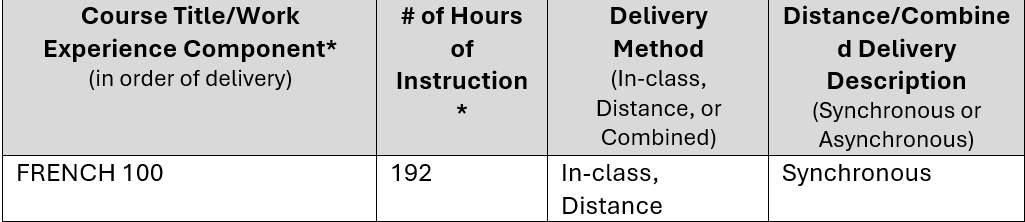
100% of instructional hours are delivered in a classroom or learning environment where instructors and students share the same physical space. Students participate in face-to-face instruction, discussions, and practical learning activities.


Distance Education:

100% of instructional hours, excluding work experience hours (if applicable), are delivered remotely from a B.C. location through online learning platforms.


Online Learning Format (if applicable):

Online instruction is delivered through synchronous learning , where students attend virtual classes in real time with instructors and classmates.

Program Organization*
Apply Now
Key Information
Powered by Joinchat