- Updated on: July 14, 2026
Program Description
French B1 Intermediate Course Description (CEFR Level)
Brief Course Description
This Intermediate French B1 course is designed for learners who have completed the beginner level and are ready to progress from Basic User (A-level) to Independent User (B-level) proficiency according to the Common European Framework of Reference for Languages (CEFR).
Aligned with the CEFR B1 (Threshold) level, this French language course helps students develop the skills needed to communicate effectively in everyday and professional situations. Learners will improve their ability to understand and respond to standard French speech, express personal opinions, describe experiences, and participate in spontaneous conversations on familiar topics.
The course focuses on developing strong French communication skills, including:
- Producing clear and connected spoken discourse
- Understanding standard French conversations related to work, school, leisure, and current affairs
- Sharing personal experiences, ideas, and opinions with confidence
- Writing coherent French texts about personal interests and life experiences
- Building vocabulary, grammar accuracy, and conversational fluency
By the end of this French B1 intermediate course, learners will be able to function as independent French speakers and confidently handle a variety of familiar real-world communication contexts.
A benchmark for progression via CEFR is as follows:
B1 (Intermediate – 350 hours )
Please note that these hours are estimates only
Important Notes:
- 5:00 – 7:00 PM classes are conducted In-Person.
- All other time slots are conducted Online.
Current Class Timings:
| Day | Available Time Slots | Class Format |
|---|---|---|
| Monday | 9:00–11:00 AM, 12:00–2:00 PM, 3:00–5:00 PM, 5:00–7:00 PM | Online (except 5:00–7:00 PM In-Person) |
| Tuesday & Thursday | 12:00–6:00 PM | Online |
| Wednesday | 9:00–11:00 AM, 12:00–2:00 PM, 3:00–5:00 PM, 5:00–7:00 PM | Online (except 5:00–7:00 PM In-Person) |
| Friday | 9:00–11:00 AM, 12:00–2:00 PM, 3:00–5:00 PM, 5:00–7:00 PM | Online (except 5:00–7:00 PM In-Person) |
| Saturday | 9:00 AM–12:00 PM, 12:00–3:00 PM, 1:00–4:00 PM, 4:00–8:00 PM, 5:00–7:00 PM | Online (except 5:00–7:00 PM In-Person) |
| Sunday | 9:00 AM–12:00 PM, 12:00–3:00 PM, 1:00–4:00 PM, 4:00–8:00 PM, 5:00–7:00 PM | Online (except 5:00–7:00 PM In-Person) |
Demo Classes:
Monday, Wednesday and Friday 11:00 AM – 12:00 PM & 4:00 PM – 5:00 PM
Saturday, Sunday 3:00 PM – 4:00 PM
Course Prerequisites
Successful completion of French A2 or equivalent CEFR A2-level French proficiency is required before enrolling in this course.
Required Course Materials
Main Textbook:
Édito B1 — Méthode de français
Additional learning materials will be provided by the instructor, including:
- French audio resources
- Video clips
- Authentic French documents
- Online learning resources
Curriculum and lesson hours are based on:
Faculty Profile
Meet our experienced and dedicated faculty members who will guide you throughout your French language learning journey.
| Faculty Name | Exp | Education | Skills / Expertise |
|---|---|---|---|
| Prof. BASSINGA NSIMBA JUSTIN JR | 💼 10+ years | 🎓 M.B.A. – Zhejiang Normal University, China. 🎓 B.A. Linguistics & English Language – Marien Ngouabi University, Congo. 🎓 Test of French Knowledge (TCF). 🎓 Training in Teaching English as a Foreign Language (TEFL). | ⭐ FLE Teaching ⭐ DELF A1–C1 Instruction ⭐ Lesson Planning ⭐ Classroom Management ⭐ Proficient French Speaker |
| Prof. YAO SONKA | 💼 8+ years | 🎓 Master of Arts: Didactics of French University of Dijon – France 🎓 Master of Arts: Didactics of French University of Strasbourg – France | ⭐ Educational Leadership Certificate – Various Educational Institutions. ⭐ Assisted with special events and programs. ⭐ Documented and resolved language barriers facing students which led to 75% success. ⭐ Proficient French Speaker |
| Prof. Nnaemeka Hubert Odikamnoro | 💼 8+ years | 🎓 Master of Arts in French. 🎓 Bachelor of Arts in French. | ⭐ Diplôme Approfondi en Langue Française (DALF), C1 ⭐ Diplôme d’Études en Langue Française (DELF), B2 ⭐ Proficient French Speaker |
| Prof. Zélie Jeanne Edith EVE | 💼 6+ years | 🎓 Master’s Degree in Teaching French as a second or foreign language. 🎓 Bachelor of Arts in Chinese Language and Literature. | ⭐ Multilingual Communication (French C2, English C1, Spanish B2, Mandarin HSK 4). ⭐ French Language Teaching & Curriculum Design ⭐ DELF, DALF, TCF & TEF Exam Preparation. ⭐ Online Teaching & Educational Technologies. ⭐ Proficient French Speaker. |
| Prof. Hamza Benhanida | 💼 4+ years | 🎓 High-School Diploma – Chinese L2. 🎓 Bachelor Computer Science. 🎓 Bachelor Business Administration. | ⭐ Grammar ⭐ Vocabulary ⭐ Exam Preparation ⭐ Proficient French Speaker |
Week-by-Week Schedule
Meet our experienced and dedicated faculty members who will guide you throughout your French language learning journey.
| Week | Theme | Topics & Language Points | Weekly Outcomes |
|---|---|---|---|
| Week 1 | Retour sur l’essentiel | – French alphabet and – Diagnostic review of A2 structures: passé composé, near future, basic connectors – Introduction to the imparfait (descriptions and habits in the past) – Contrasting passé composé and imparfait – Expanding vocabulary: work, school, and leisure – Narrating a personal anecdote | – Distinguish between completed actions and background descriptions in the past – Narrate a short personal experience using connected sentences – Identify one’s own strengths and gaps from A2 |
| Week 2 |
Vie quotidienne et loisirs | – Travel vocabulary: accommodation, transport, itineraries – Dealing with most situations likely to arise while travelling – The conditional (je voudrais, j’aimerais) for polite requests and hypothetical wishes | – Deal with most practical while travelling in a French- – Describe experiences, |
| Week 3 | Voyages et découvertes | – Travel vocabulary: accommodation, transport, itineraries – Dealing with most situations likely to arise while travelling – The conditional (je voudrais, j’aimerais) for polite requests and hypothetical wishes | – Deal with most practical while travelling in a French- – Describe experiences, |
| Week 4 | Raconter et réagir | – Narrating stories, relating the plot of a book or film – Describing reactions, feelings, and impressions – The plus-que-parfait (introduction) – Time markers and sequencing (d’abord, ensuite, enfin, après que) – Writing a personal letter describing experiences and impressions | – Narrate a story or relate the plot of a book or film and describe one’s reactions – Understand the description of events, feelings, and wishes in personal letters – Write personal letters describing experiences and impressions |
| Week 5 | Rêves, projets et ambitions | – Places in a city (la boulangerie, la gare, etc.) – Prepositions of location (à côté de, en face de, etc.) – Asking for and giving simple directions – The verb aller + à/au/à la/aux – Imperative forms for directions (tournez, alleztout droit) | – Describe dreams, hopes, and ambitions and briefly explain reasons for them – Give explanations for opinions and plans – Enter unprepared into conversation on current events and topics pertinent |
| Week 6 | S’exprimer et convaincre | – Expressing and justifying a | – Briefly give reasons in support of or against a point of view – Produce simple connected text on topics of personal interest – Give a short presentation on a familiar topic, handling straightforward follow-up questions |
| Week 7 | Bilan et évaluation | – Comprehensive review of all communicative functions, grammar, and – Integrated skills practice: | – Demonstrate B1-level competence across all four |
Admission Requirements
Applicants must meet one of the following admission requirements:
- C. Secondary School Graduation: Completion of British Columbia secondary school graduation or an equivalent credential.
- Mature Student Admission: Applicants who are 19 years of age or older and have been out of secondary school for at least one year as of the first day of classes may also be eligible for admission.
Learning Objectives
Upon successful completion of this course, the student will have reliably demonstrated the ability to:
Global Scale — Overall Communicative Ability
Reference: CEFR Table 1 — Common Reference Levels: Global Scale
• Understand the main points of clear standard speech on familiar matters regularly encountered in
work, school, leisure, and similar contexts.
• Deal with most situations likely to arise whilst travelling in an area where French is spoken.
• Produce simple connected text on topics which are familiar or of personal interest.
• Describe experiences and events, dreams, hopes, and ambitions and briefly give reasons and explanations for opinions and plans.
Reception — Listening and Reading
Reference: CEFR Table 2 — Self-Assessment Grid (B1 Reception)
• Understand the main points of clear standard speech on familiar matters regularly encountered in
work, school, and leisure.
• Understand the main point of many radio or TV programmes on current affairs or topics of personal
or professional interest when the delivery is relatively slow and clear.
• Understand texts that consist mainly of high-frequency everyday or job-related language.
• Understand the description of events, feelings, and wishes in personal letters.
• Follow clearly written instructions and informational texts on familiar subjects.
• Identify the main conclusions in clearly signalled argumentative texts.
Interaction — Spoken and Written
Reference: CEFR Table 2 — Self-Assessment Grid (B1 Interaction)
• Deal with most situations likely to arise whilst travelling in an area where French is spoken.
• Enter unprepared into conversation on topics that are familiar, of personal interest, or pertinent to
everyday life (e.g., family, hobbies, work, travel, and current events).
• Initiate, maintain, and close simple face-to-face conversation on topics that are familiar or of
personal interest.
• Repeat back part of what someone has said to confirm mutual understanding.
• Express and respond to feelings such as surprise, happiness, sadness, interest, and indifference.
• Make and respond to complaints; handle practical everyday demands such as finding out and
passing on straightforward factual information.
• Write simple connected text on topics which are familiar or of personal interest.
• Write personal letters describing experiences and impressions.
Production — Spoken and Written
Reference: CEFR Table 2 — Self-Assessment Grid (B1 Production)
• Connect phrases in a simple way in order to describe experiences and events, dreams, hopes, and
ambitions.
• Briefly give reasons and explanations for opinions and plans.
• Narrate a story or relate the plot of a book or film and describe one’s reactions.
• Give a straightforward description on a variety of familiar subjects within one’s field of interest,
presenting it as a linear sequence of points.
• Reasonably fluently relate a straightforward narrative or description as a sequence of points.
• Give a short, prepared presentation on a topic within one’s field, with reasons and explanations for
opinions, plans, and actions, and cope with straightforward follow-up questions.
• Write simple connected text on topics which are familiar or of personal interest, linking a series of
shorter discrete elements into a linear sequence.
• Write personal letters describing experiences, impressions, feelings, and events in some detail.
Qualitative Aspects of Spoken Language Use
Reference: CEFR Table 3 — Qualitative Aspects of Spoken Language Use (B1)
• Range: Command enough language to get by, with sufficient vocabulary to express oneself with
some hesitation and circumlocutions on topics such as family, hobbies and interests, work, travel,
and current events.
• Accuracy: Use reasonably accurately a repertoire of frequently used routines and patterns
associated with more predictable situations.
• Fluency: Keep going comprehensibly, even though pausing for grammatical and lexical planning and
repair is very evident, especially in longer stretches of free production.
• Interaction: Initiate, maintain, and close simple face-to-face conversation on topics that are familiar or of personal interest; repeat back part of what someone has said to confirm mutual understanding.
• Coherence: Link a series of shorter, discrete simple elements into a connected, linear sequence of
points.
Communication Strategies
Reference: CEFR Illustrative Scales (B1 Strategies)
• Use a variety of strategies to achieve understanding, including listening for main points and
checking comprehension by rephrasing.
• Ask someone to clarify or elaborate on what they have just said.
• Convey meaning by qualifying a word with a similar meaning (e.g., paraphrasing) when the exact
word escapes recall.
• Define features of something concrete for which the exact term cannot be recalled.
• Begin, maintain, and close simple conversation on familiar topics; use stock phrases to gain time
and keep one’s turn while formulating what to say.
Additional Information
Method(s) of Evaluation*
Students will be evaluated through a combination of assessments, including:
- Quizzes
- Assignments
- Midterm Exam
- Final Exam
- Classroom Participation
Assessments are designed to measure student’s understanding, progress, and ability to apply the knowledge and skills learned throughout the program.
Completion Requirements*
Students must achieve a minimum overall grade of 70% or higher to successfully complete the program.
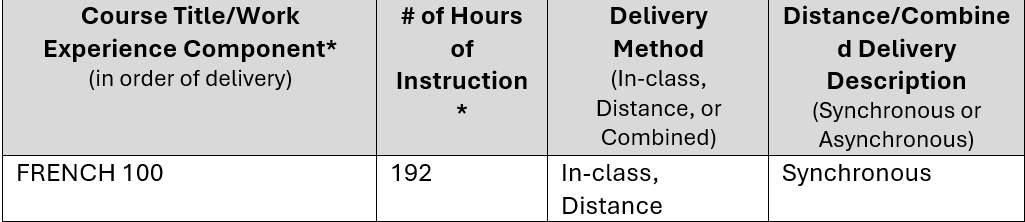
Delivery Method(s)
Students must achieve a minimum overall grade of 70% or higher to successfully complete the program.
Delivery Method(s)
The program is delivered through the following methods:
In-Class Instruction:
100% of instructional hours are delivered in a classroom or learning environment where instructors and students share the same physical space. Students participate in face-to-face instruction, discussions, and practical learning activities.
Distance Education:
100% of instructional hours, excluding work experience hours (if applicable), are delivered remotely from a B.C. location through online learning platforms.
Program Organization*
Apply Now
Key Information
- Start Date: Continous Intakes
- Program Duration: 22-25 Hours Per Week
-
Total Instruction
Hours: 20hours/week - Homework Hours: 8–10 hours/week based on individual learning pace.
- Total Tuition Fee: $180 Week (Online) $250 Week (in-Class)
- Delivery Method(s): In-class instruction + Online
Posted on Google Mila LiuTrustindex verifies that the original source of the review is Google. Very great learning place with very friendly and supportive staff. Highly recommendedPosted on Google Jane TaoTrustindex verifies that the original source of the review is Google. I came into the program with no pharmacy background, but the instructors explained everything step by step. It was a great learning experience.Posted on Google Yiping ZhangTrustindex verifies that the original source of the review is Google. The campus has a welcoming environment, and everyone was friendly. Whenever I had questions, the staff responded quickly and professionally.Posted on Google Qi XuTrustindex verifies that the original source of the review is Google. The Pharmacy Assistant program covered both theory and practical skills. I especially liked learning about prescription processing and customer service.Posted on Google Joe LiuTrustindex verifies that the original source of the review is Google. I had a positive experience studying at Apex Community College. The instructors were patient, and the classes were practical. I learned skills that I can actually use in the workplace.Posted on Google Sanyam SharmaTrustindex verifies that the original source of the review is Google. They are very good at teaching french . Best classes in townPosted on Google Shagun SharmaTrustindex verifies that the original source of the review is Google. I had a great experience completing the Pharmacy Assistant program at Apex Community College. The instructors were knowledgeable, experienced, and genuinely supportive, making every class engaging and practical. I learned a lot and felt well prepared for the field. I highly recommend Apex Community College to anyone considering this program.Posted on Google Divroop SandhuTrustindex verifies that the original source of the review is Google. Excellent French program with supportive instructors and a positive learning environment.Posted on Google Muskaan kambojTrustindex verifies that the original source of the review is Google. I completed my ECEA certification from this college, and it was a wonderful experience. The staff is very friendly, supportive, and approachable. They helped me with all the questions and concerns I had throughout the program. I truly appreciate their guidance and would recommend this college to anyone pursuing an ECEA certification.Google rating score: 5.0 of 5, based on 23 reviewsVerified by TrustindexTrustindex verified badge is the Universal Symbol of Trust. Only the greatest companies can get the verified badge who has a review score above 4.5, based on customer reviews over the past 12 months. Read more